


Rio de Janeiro
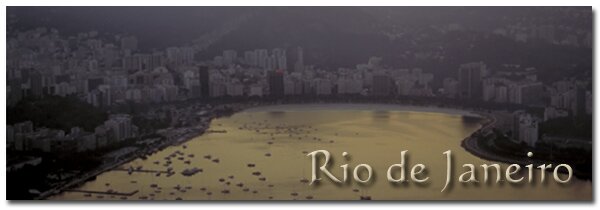
Rio de Janeiro is without doubt the most mesmerizing city of South America. The city is famous for its beaches Copacabana and Ipanema, for the giant Jesus statue known as "Cristo Redentor" (Christ the Redeemer) on the Corcovado mountain, for the Sugar Loaf mountain and... Carnival. My picture, taken from Sugar Loaf mountain, shows a spectacular sunset above Guanabara Bay, considered to be a wonder of nature.
It was reached by Portuguese explorers in an expedition led by Italian Amerigo Vespucci in January of 1501. Since the Europeans thought at first the Bay of Guanabara was actually the mouth of a river.
They called it "Rio de Janeiro" (meaning "River of January" in Portuguese).
Rio de Janeiro Tours: See all our Brazil tours
 Beija Flor Rio Carnival Package - SARC6 Beija Flor Rio Carnival Package - SARC6TOUR TYPE: Specialist Tour TRAVEL TO: Brazil |
6 Days | Price and Tour Details |
 Rio & The Route of Gold - RDO Rio & The Route of Gold - RDOTOUR TYPE:4**** Tour TRAVEL TO: Brazil |
8 days | Price and Tour Details |


The exact place of Rio's foundation is at the feet of now world famous Sugar Loaf mountain (Pão de Açúcar). Later, the whole city was moved within a palisade on top of a hill, imitating the medieval European strategy of defense of fortified castles - the place was since then called Morro do Castelo (Castle Hill). Therefore, the city developed from current Downtown (Centro, see below) to southwards and then westwards, an urban movement which lasts until nowadays.
City districts
Rio de Janeiro is commonly divided into the historic downtown (Centro); the tourist-friendly South Zone, with world-famous beaches Copacabana and Ipanema; the industrial North Zone; the West Zone; and the newer Barra da Tijuca region.
Centro
Centro is the historic downtown of Rio de Janeiro. Sites of interest include both the historic Church of the Candelaria and the modern-style cathedral, the Municipal Theater, and several museums. Centro remains the heart of the city's business community. The "Bondinho", a trolley car, leaves from a downtown station, crosses a former Roman-style aqueduct - the "Arcos da Carioca" built in 1750 and converted to a tram viaduct in 1896 - and rambles through the hilly streets of the Santa Teresa neighborhood nearby.

Christ The Redeemer - O Cristo Redentor
Christ, The Redeemer
The statue of Christ, the Redeemer is the main symbol of Rio de Janeiro. The immense Jesus statue is over 70 years old, 30 meters (98 feet) high and the view from the Corcovado mountain (710 meters (2,329 feet)) is one of the most beautiful views on the planet. You can take a comfortable elevator if your feet don't fancy the 220 steps that lead up to the Statue of Christ the Redeemer. The Corcovado mountain is situated on the Carioca Mountain Range and constitutes part of the Tijuca National Park.
Check out some of these wonderful Rio de Janeiro budget hotels
and amazing hotels in Rio de Janeiro!
South Zone
The Southern zone of Rio de Janeiro is composed of several districts, amongst them are São Conrado, Leblon, Ipanema, Arpoador, Copacabana, Leme, Botafogo and Flamengo which composes Rio's famous beach coastline. The neighborhood of Copacabana beach boasts one of the world's most spectacular New Year's Eve parties, as more than two million revelers crowd onto the sands to watch the firework display. As of 2001, the fireworks have been launched from boats, to further guarantee the safety of the event.
Passing Copacabana and Leme, on the district of Urca lies the Sugarloaf Mountain (Pão de Açúcar), whose name characterizes the famous hump rising out of the sea. The top can be reached via cable car, accessible from the Hill of Urca ("Morro da Urca"), and offers views second only to Corcovado mountain.
The tallest mountain in Rio de Janeiro, however, at 842 meters (2,762 feet), is the Pedra da Gávea (Topsail Rock) in São Conrado. Hang gliding is a popular activity in a nearby peak - after a short flight, they land on the Praia do Pepino beach in São Conrado.
North Zone
The North Zone of Rio de Janeiro is home to the Maracanã stadium, still the world's highest capacity football venue, able to hold nearly 200,000 people. In modern times, the capacity has been reduced to conform with modern safety regulations, and the introduction of seating for all fans. Currently undergoing renovation, it will eventually hold around 120,000.
West Zone
The West Zone is the metropolitan region which is most distant from the Center of Rio de Janeiro. It includes Barra da Tijuca, Jacarepaguá, Campo Grande, Santa Cruz and Bangu. Barra da Tijuca remains an area of accelerated growth, attracting mainly the richer sector of the population, whereas neighboring districts within the West Zone reveal stark differences between social classes.
The area has industrial zones, but some agricultural areas still remain in its wide area. Beyond the neighborhoods of Barra da Tijuca and Jacarepagua, another district which has exhibited good economic growth is that of Campo Grande.
Barra da Tijuca
To the west of the older zones is Barra da Tijuca, a flat expanse of formerly undeveloped coastal land, which is currently experiencing a wave of new construction. High rise apartments and sprawling shopping malls give the area a far more Americanized feel than the crowded city center (Centro).
The urban planning of the area, made in the late 1960s, resembles that of North American suburbs, though mixing housed zones with residential skyscrapers. This has attracted businesses to move to the area to take advantage of this. The large beaches of Barra da Tijuca are also popular with the city's residents.
Favelas
Rio de Janeiro is a city of contrasts, and though much of the city clearly ranks alongside the world's most modern metropolises, a significant percentage of the city's 13 million inhabitants do still live in areas of poorer quality housing. The worst of these poorer areas are the slums and shanty towns known as favelas, often crowded onto the hillsides where sturdy buildings are difficult to build, and accidents, mainly from heavy rainfall, are frequent. The favelas are troubled by widespread drug related crime and gang warfare and other poverty-related social issues.
Attractions of "A Cidade Maravilhosa"Ipanema Beach Copacabana Beach Sugar Loaf Mountain (Pão de Açsucar) |
City of God (Cidade de Deus)

City of God (Cidade de Deus) is one of the most spectacular movies that has been produced in Latin America. It tells the story of a poor housing project started in the 60's that became one of the most dangerous places in Rio de Janeiro by the beginning of the 80's.
The story centers around the narrator, Busca-Pé, a poor black kid too frail and scared to become an outlaw but also too smart to be content with an underpaid job. He grows up in a very violent environment. The odds are all against him. But he discovers he can see the reality with a different eye: the eye of an artist. Eventually he becomes a professional photographer. That is his redemption.
Busca-Pé is not the real protagonist of the film. He is not the one who makes the story moves on. He is not the one who makes the decisions that will determine the main chain of events. Nevertheless, not only his life is attached to what happens in the story but it is also through his perspective of life that we understand the humanity of a world apparently condemned to endless violence.
Other Must See Places in Brazil
| Salvador da Bahia | Ouro Preto | Brasilia |
 |
 |
 |
Brazil
Food from Brazil
Music From Brazil
Pantanal
----------
0 Comments
Have something to say about this article?
Feel free to share your views, travel experiences, tips and tricks, etc... about this article. All comments are moderated and do not appear instantly. Please keep your comment relevant to this article. You will not see a confirmation message after submitting your comment but rest assured, we got it.
© All photographs by Mark Van Overmeire*
*except photograph "Christ The Redeemer" by Zina Seletskaya | Agency: Dreamstime.com
This article is licensed under the GNU Free Documentation License.
It uses material from the Wikipedia article "Rio de Janeiro"